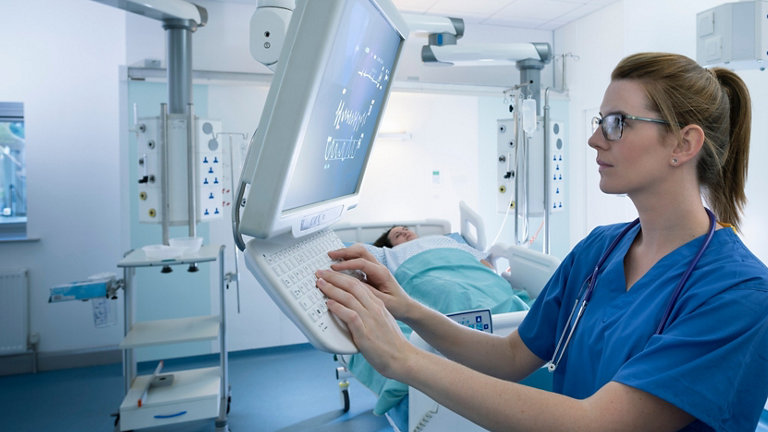
Major changes to Britain’s healthcare system are afoot. The focus is shifting from treating illness to preventing it with proactive, data-driven health management. The NHS Long Term Plan, which sets out ambitious health service priorities for the future, will see community care prioritised over hospital admissions and a greater focus on digital solutions to boost efficiency.
This is all in a bid to cope with the UK’s rising healthcare needs using finite resources. The approach rests heavily on one essential ingredient: connectivity. To make personalised, preventative care possible, clinicians, systems and patients must link together in real-time through fast, secure digital networks.
Making preventative care possible at scale
Achieving the goals set out in the NHS Long Term Plan requires a new kind of health ecosystem in which hospitals, GPs, community services and patients can all share information quickly and without glitches.
Clinicians get an instant, holistic picture of a patient’s health, wherever they are being treated, and can make decisions based on timely, accurate data. Real-time insights flag issues well before they become emergencies, easing pressure on hospitals and improving outcomes.
The move towards prevention also relies on people being active participants in their own care. Innovations in consumer technology mean wearables such as smart watches, blood pressure monitors and glucose sensors are giving patients new ways to track their health and share data with care teams.
But the innovations are only as good as the networks supporting them, particularly at the healthcare provision end of the equation, where connectivity needs to be fast, reliable and secure enough to handle sensitive data safely.
However, our research suggests this isn’t always the case. Our new Future Unlocked research shows that many healthcare workers feel the technology in their pockets is more advanced than the technology they rely on at work. Others report that patchy hospital Wi-Fi forces them to search for a signal, rather than work seamlessly across locations.
Our research also shows that improved connectivity could unlock productivity gains equivalent to freeing up two days per year for every health worker. At an individual level, the impact may appear small, but across the entire NHS workforce, however, this equates to 18.1 million workdays – or 49,600 years.
At BT, we have seen first-hand how connected infrastructure can transform community health, from remote consultations that cut the need for travel to ‘virtual wards’ that monitor people at home after surgery. Reliable connectivity means care can be delivered how, where and when it is needed most.
Care powered with connectivity
Artificial intelligence and the Internet of Things open new possibilities for healthcare. AI can help identify early signs of disease, speed up diagnosis and tailor treatment to the individual. Connected sensors and smart devices feed data into these systems, helping clinicians make faster decisions.
Without the right digital infrastructure, however, this kind of brilliant innovation simply can’t scale. Data must be free to move securely between systems and often across different organisations – without delay or loss of quality.
In a modern healthcare system, connectivity is a clinical requirement as well as a technical one. Barriers to information sharing can impact outcomes; gaps in coverage can equate to frustrations and delay – meaning patients ultimately lose out. With powerful and secure networks, healthcare organisations suffer no such burdens.
Our work with NHS partners shows what this looks like in practice. We help to connect hospitals and community health teams through private networks that keep sensitive information safe. Our advanced monitoring tools help to spot and solve issues before they impact service, keeping systems running smoothly.
In a pilot project with University Hospitals Birmingham (UHB), our Remote Diagnostic Station let clinicians work with multi-disciplinary teams and offered remote clinical support using digital stethoscopes and ECGs. They reviewed patients and provided diagnoses in real-time, from any location, over a combined 4G/5G and Wi-Fi network.
Supporting the NHS through digital infrastructure
Improvements over the next decade in healthcare will be defined by the strength of the NHS’ digital infrastructure. As services move online and patient data becomes more complex, demand on networks will grow.
Our recently created sovereign platform empowers healthcare organisations to harness the potential of AI and IoT. Built for resilience, it delivers the reliable connectivity needed for clinical workloads, maintaining continuity even in the face of geopolitical challenges or network disruptions.
We’re proud to be part of that journey and are investing in intelligent, secure networks, ensuring data can travel safely between settings and supporting care where it matters most. We work with NHS partners to build in resilience from the start, designing digital infrastructure that can scale with demand and stand up to future cyber threats.
When connectivity works well, it creates the conditions for better care. Patients can benefit from more personalised, proactive support, while healthcare workers have timely access to the information they need to make confident decisions. By connecting systems and people reliably and securely, organisations are better placed to support long-term improvements in population health.
Related products
- Health Cloud
- Finding flexibility with Future Wireless