How we're helping housing providers move from reactive fixes to proactive responses, improving services in a system under pressure.
18 June 2026
8 minutes
How BT delivers smarter housing
At BT, we bring together connectivity, platforms and services to help housing providers scale solutions and turn insight into action. This makes it easier to deliver safer homes, run more efficiently and improve experiences for residents, supporting stronger, more resilient communities.
Moving from reactive to proactive services
Awaab’s Law
Social housing is at a breaking point. Rising demand, ageing populations, and increasingly complex resident needs are placing sustained pressure on services as financial capacity erodes. At the same time, regulation is tightening. Since April 2024, the introduction of proactive inspections and stronger consumer standards has raised expectations on landlords significantly.
Most notably, Awaab’s Law, introduced in October 2025, requires social housing landlords to fix emergency hazards within 24 hours, and investigate hazards within strict time frames. Non-compliance can lead to legal action, fines and compensation. Learn more about Awaab’s Law.
Financial strain
Many housing providers lack the resources to manage them effectively. The financial strain is stark: councils have spent more than they’ve earned on housing in four of the past five years, with nearly three-quarters (72%) relying on reserves to balance budgets.
Much of the cost in social housing isn’t immediately visible. It sits in fragmented processes and the inefficiencies of reactive working. Every manual inspection, repeat visit, and emergency call-out adds pressure.
A safer community
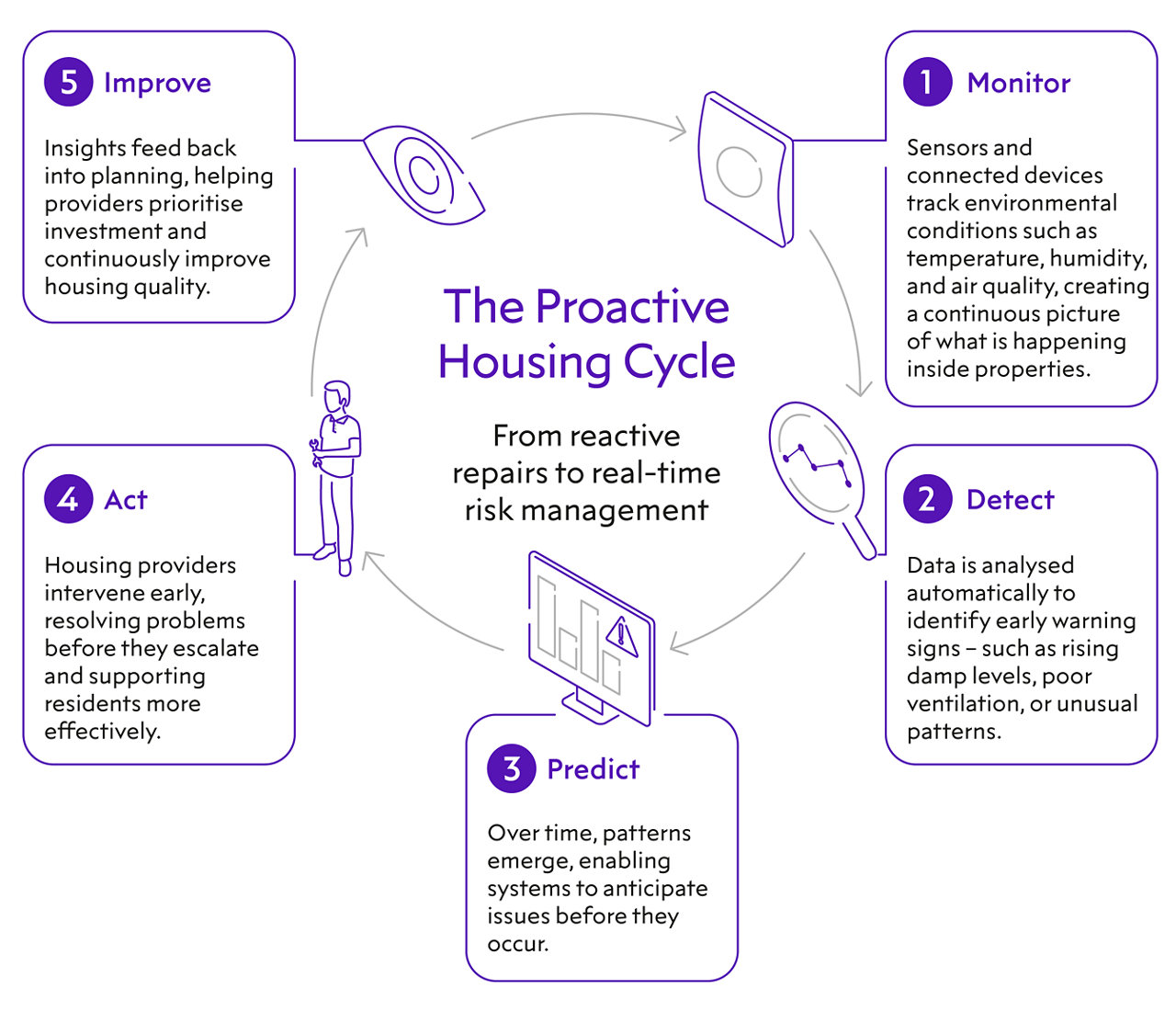
A fundamental shift is underway - from crisis response to early intervention, foresight is now favoured over firefighting.
Powered by connectivity, in-home sensors, and integrated data platforms, housing is becoming a source of real-time insight. This allows providers to identify risks earlier and deliver more proactive, personalised services.
In this context, housing is more than just a service; it’s a foundation for safer, healthier, and more inclusive communities. But the window to act is narrowing – and without change, providers risk becoming locked into an unsustainable cycle of reactive costs, regulatory pressure, and worsening outcomes for residents.
Proactive housing in practice
Making data count
Preventative housing isn’t just about data, it’s about knowing what to act on first. Without prioritisation, issues can quickly overwhelm already stretched teams. Value comes from turning insight into action, focusing on the highest risks and where effort will have the most impact.
The following scenarios show this in practice:
Scenario 1: Early intervention
A housing officer receives an alert: humidity levels in a property have been consistently high for several days. There’s no visible mould yet, and the resident hasn’t raised a complaint, but the data suggests conditions are deteriorating. Instead of waiting for the issue to surface, the provider intervenes early. A repair is scheduled to check ventilation, and the resident is contacted with simple guidance. The problem is resolved before it escalates.
Scenario 2: Supporting vulnerable residents
An elderly resident who usually follows a consistent routine shows a sudden change in behaviour. Heating use drops, and movement patterns suggest they may not be active as usual.
There is no emergency call, but something is not right. Through non-intrusive monitoring, this change is flagged, prompting a welfare check.
Support is provided early, preventing a potentially serious incident.
Scenario 3: Creating safer estates
A communal bin store fills up faster than expected overflowing for several days. Usually, this would be addressed once during a scheduled visit. With connected estate management, fill levels are monitored in real time.
When thresholds are reached, an alert is triggered automatically, allowing collection to be scheduled before overflow occurs.
This improves estate conditions while optimising operations – freeing up teams to focus on higher-priority work.
Smart housing: the foundation
Smarter housing starts with strong digital foundations—reliable connectivity and inclusive access to services. Without this, data and technology can’t deliver value. For residents, connectivity opens access to essential services, while for housing providers it enables real-time visibility across homes and estates, helping identify issues earlier and respond faster.
The real impact comes from bringing everything together. A unified platform connects data across homes and services, giving housing teams a clear, shared view of where to act. This turns insight into action by improving coordination, decision making and day-to-day efficiency.
Smarter housing: the outcome
Smarter housing goes beyond individual homes to improve how services work together. Trust is essential. Approaches need to be clear, show real benefits to residents and use non-intrusive technologies focused on environments rather than individuals. Done well, housing becomes a foundation for healthier, more connected communities. This is built over time through trust, evidence and integration.
This shift is not just about technology. It is about better outcomes. By moving from reactive fixes to proactive support, housing providers can identify risks earlier and act before issues escalate. For residents, this means quicker resolutions, fewer disruptions and safer, more comfortable homes.
It also supports more independent living, especially for vulnerable residents. People have reassurance that help is there when needed. For providers, it reduces unnecessary visits, lowers costs and improves how resources are used. Overall, it creates a more efficient and connected system, improving everyday experiences for residents while giving providers greater control.
Related products
Surveillance maintenance
Take the hassle out of maintaining your surveillance network with our fully managed, end-to-end service.