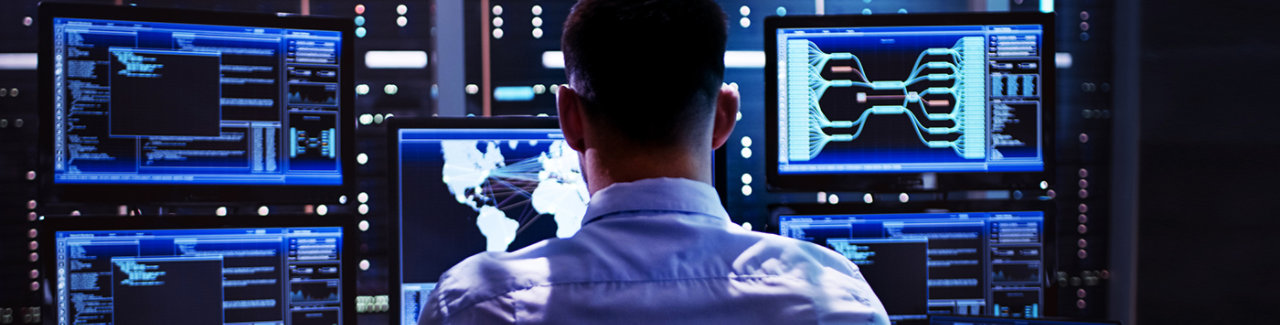
Detect and respond to security information in real time with our managed and cloud SIEM services.
Why your business needs SIEM
Cyber attacks are getting more sophisticated and identifying genuine threats puts a huge demand on your security team. We offer a choice of SIEM solutions to keep your assets safe around the clock.
Reduce pressure on in-house teams
Remove false positives and focus on the genuine threats to your organisation.
Enhance security
Stop threats in their tracks with rapid threat detection and swift response times.
Understand threats better
Reduce the signal-to-noise ratio and extract actionable intelligence and data.
Our SIEM solutions
Our scalable solutions can protect the security needs of any business. We help over-stretched security teams who are suffering from alert fatigue or struggling to get set up.
Choose between Cloud SIEM which is ready-to-use with no upfront cost, and Managed SIEM, which we configure and run on your behalf.
Our cloud security solutions keep you secure while maintaining connectivity throughout your organisation.
Total products listed 3. Total products hidden 0.
Why choose BT for your SIEM solution
Our solutions give you the intelligence you need to protect your business from evolving threats.
24/7 monitoring
Our community of security experts act as an extension of your team, allowing you to focus on your business.
Working on your behalf
We’ll work with you to tune your platform, meet your detection requirements and take advantage of proven playbooks.
Global track record
We have years of experience providing cyber security transformation programmes to businesses of all sizes around the world.
Intelligence
Our CREST-accredited threat intelligence capabilities lie at the heart of how we protect our customers.
BT has been an excellent partner and the team is highly motivated, engaged, and innovative in bringing new technology partners to enable automation and advanced cybersecurity protection.
SIEM stands for security information and event management system, and it’s designed to give you better visibility of what’s happening across your IT estate. It does this by gathering data from sources like networks and anti-virus software, and analysing that data for suspicious activity. It also allows you to log security incidents and help you stay compliant with data regulations.
SOC v SIEM: what’s the difference?
SOC stands for security operations centre. It’s where security staff monitor data (like alerts and traffic) and make decisions on how to respond to possible threats. SIEM, on the other hand, is software that helps to analyse and identify potential threats on your network. So SIEM is a tool to help SOCs do their job more effectively. Without SIEM, security teams would have to manually gather data from various sources – which would take a long time.
How does SIEM help with compliance?
To comply with data protection law, organisations need to organise, store and protect data in a way that prevents it from being compromised. Because SIEM has visibility across the entire organisation, it’s an excellent tool for documenting and providing a record of all data events.
The acceleration of digital transformation has increased the potential attack surface. Do you need better visibility of threats across your estate?
Cloud services play an essential role in any digital strategy – but they bring complex challenges. Choose a cloud security service you can rely on.